|
What's new again still feels kinda old, as the transformation that changed the Cubs' Hohokam Park into the Athletics' Hohokam Stadium didn't alter all that much of what has always been a pretty simple structure that was substantial in size but unimaginative in design.
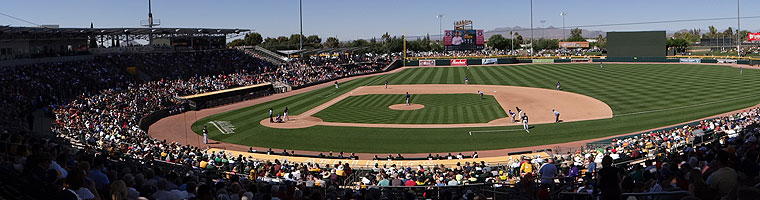
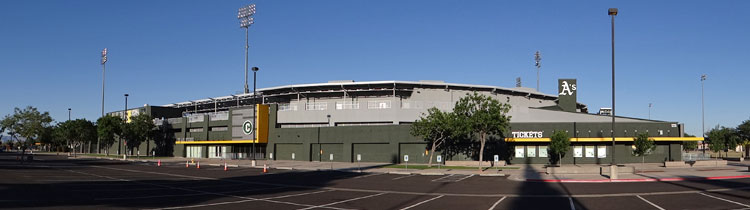
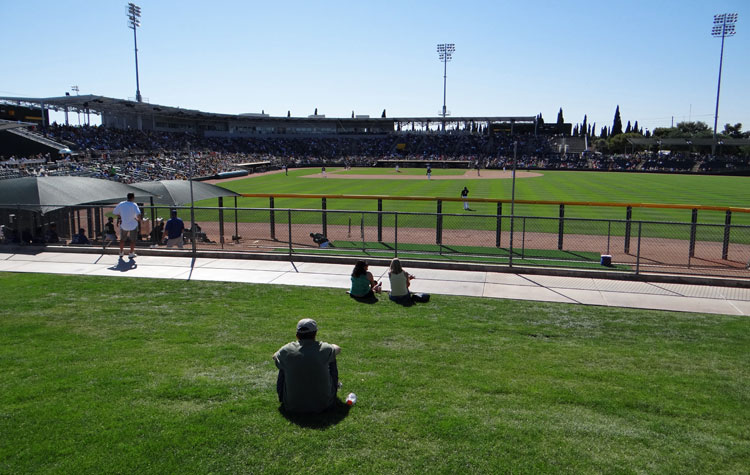
Opened in the post-Camden Yards era when blueprints finally got creative, or at least relied on retro quaintness, this is one place that managed to buck that trend and when it was given new life in 2015 it still clung to its big box-like basicness. But at least much of the edifice that used to be so bland is now bathed in green and gold while capacity was downsized by a few thousand thanks to the removal of the big banks of bleachers that were down each outfield line. However, the more colorful confines still feel oversized, which most people first experience upon entrance into the stadium’s cavernous concourse, which spans the backside of the large split-level grandstand that now holds all of the park’s fixed seats. A main concourse that has no view of the field is a big a no-no nowadays and was becoming rarer in 1997, when Hohokam made its debut as the Cubs’ winter home. Refurbished 18 years later to the tune of what it cost to build (roughly $18 million in both cases), the difference between the original and renewed version is minimal. Cases in point on the changes: Gathering space shaded by metal canopies replaced the aforementioned bleachers along each outfield line. Seating rows were renumbered; they used to be lettered, so now, for example, rows span 1 to 12 rather than A to L in sections that have a dozen rows. The entrance to the team shop on the third base concourse was made more appealing, as were the entrance gates themselves. So small stuff like that, with one big exception: the scoreboard in left field is now one big board of fully high-definition capable video. It’s certainly a fun thing to stare at when you need a distraction and given the scoreboard’s bigness – it’s the largest in the Cactus League – Mesa’s stadium can rightfully be called the home of the whopper. Otherwise, the place remains known for having a decent amount of lawn seating in the outfield and nice views of the distant mountain ranges from its 200-level sections, which are those that are above a wide aisle that splits the grandstand into lower and upper halves. If you want to enjoy the ballgame and scenery while avoiding the sun, buying a ticket for a stadium-style seat in one of the 13 sections (200-212) that go by the Terrace Box designation is your play thanks in part to the trellises that jut out from the roofline to cast shade. Such are the highlights – and they are certainly nice ones – of the stadium that lured the A’s out of Phoenix after 33 straight spring training seasons at the big city’s Municipal Stadium. Of course, the money that was poured into things fans can’t see or use, like clubhouses and workout facilities, were a big reason why the A’s moved about 10 miles east into a stadium where calling it state-of-the-art seems like a big-time stretch. In other words, Hohokam feels like the spring training version of the Coliseum in Oakland. Couple that with the green and gold colors visible everywhere and Hohokam Stadium certainly looks like an appropriate home for the A’s. Quite serviceable instead of quite sensational, don't come expecting much out of the ordinary when it comes to Hohokam Stadium, although it's only fitting that a team that brands itself as "Green Collar Baseball" plays in what’s the blue-collar stadium of spring training.
LocationHohokam Stadium is located in a residential area, with small houses and apartment complexes found nearby. Commercial ventures like bars and restaurants are completely absent from the game day scene. In a literal sense, the area around the stadium is dead, as the City of Mesa Cemetery is directly across the street. So if you don't live or are buried there, there's no reason to be near the ballpark unless the A's are playing.
ParkingThe homeowners that live close-by offer neighborhood parking. Paying up to $5 to park on their properties (across the street from Hohokam) allows fans easier access in before and out after the game. Otherwise the A's charge $5 to park in one of the 3,000 spaces on stadium property, with the public being guided into the large grass fields that are on two sides of the stadium while season ticket holders get to park in the paved lot that fronts Hohokam and is parallel to Center Street. Gypsy or official, the choice of parking is yours. Both options are safe but since traffic can be tied up for a while when trying to leave the stadium's lots there is a real benefit to contributing to the very local economy.
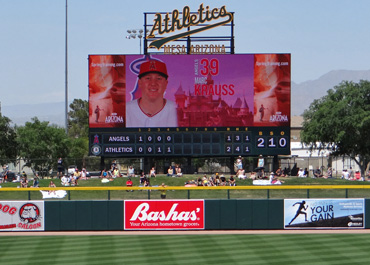
Notable Ballpark Features A large video board is in left field The scoreboard standing behind the berm in left field measures approximately 55' 3" wide by 27' 6" tall. Manufactured by Daktronics, the screen's entire surface area can show high-definition video and is usually subdivided into different sections of LED-shown content during play, when the line score is visible. The scoreboard's debut coincided with the A's arrival in 2015 and upon installation it became the largest such structure in the Cactus League and the second biggest scoreboard found at any spring training stadium (the Yankees' Steinbrenner Field in Florida upgraded to a 63' 6" x 26' all-video board in 2014). The current jumbo video board at Hohokam replaced a scoreboard that was in the same spot when the Cubs played games at the stadium, and the old structure included a video screen that was just 12' x 16' in size.
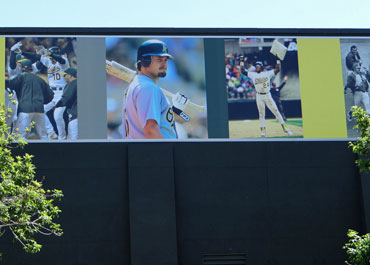
Imagery of A's history abounds on the stadium itself
Outfield berm is bulkier and includes bullpens in right field
Inverted canopies cover group areas
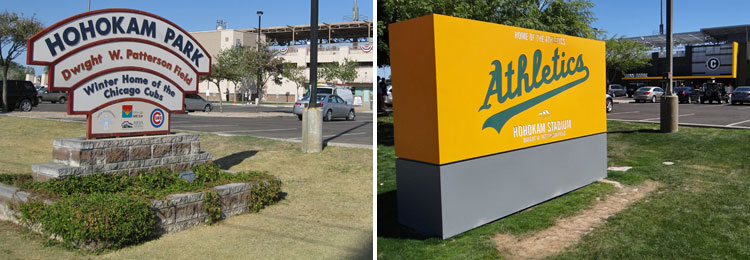
Hohokam - The People Behind The NameThe original Hohokam were an Indian tribe that flourished in central Arizona until they disappeared around the year 1450. Hence the literal translation for Hohokam, which is “those who are gone." In 1951 the HoHoKams were reborn, this time as a civic organization dedicated to bringing spring training baseball to Mesa. Led by rancher Dwight Patterson, the 34-member committee succeeded in their task by luring the Chicago Cubs away from California, where they had trained since 1917 (with the exception of the WW II years). When Rendezvous Park, the original Mesa spring training ballpark, was leveled in 1976, the new stadium was named after the influential organization responsible for attracting baseball to Mesa. Today the HoHoKams are responsible for helping to run the venue that bears their name on game days. Once upon a time, their logo was even imprinted on the tickets. That included in 2008, when the volunteer organization had 179 members and the then-mayor of Mesa, also a HoHoKam, served as an usher for the old right field bleachers section. In 2015, with the bleachers removed and the A's moved in, the official roster for the Mesa HoHoKams included 172 names. As for the name listed on the facility, Hohokam went from followed by Park in the Cubs' days to Stadium when the A's became its spring training occupants. So, after sporting Hohokam Park on its streetside sign when "Winter Home of the Chicago Cubs" was rightfully included on it, the bright gold exterior sign that now claims the place as the "Home of the Athletics" states its name as Hohokam Stadium. One thing that hasn't changed is the mission of the stadium's namesake organization, which became an official non-profit association in 1986. Besides being the spring training booster for both the A's and Cubs by handling some of the game day operations at the teams' respective Mesa-based ballparks, the HoHoKams raise funds for youth sports programs and other local charities. Yet the most visible "jobs" done by the HoHoKams, who always do them while wearing burgundy shirts, are handling parking lot operations and serving as ushers during spring training, tasks for which the volunteer operation receives some compensation, which is then fully funneled back into the local community they serve.
Hohokam Stadium Facts, Figures & Footnotes
Stadium FirstsOfficial stadium firsts (all of which occurred on 2/28/97, unless noted):
| |||||||||||||||||||||||||||||||||||||||||||||||||||||||||||||||||||||||||||||||||||||||||||||||||||||||||||||||||||||||||||||||||||||